Blackstone Griddle Steak Recipe (Perfect Crust Every Time)
Look, I’ve always considered myself to be a slightly above average cook. I can handle a grill, I make a solid burger, and my pan-seared steaks were nothing to be ashamed of. But then I got my Blackstone griddle back in April, and I’m just going to say it straight up: this is how steak was meant to be cooked. That flat top surface gets screaming hot, creates this insane crust, and somehow keeps everything juicier than any other method I’ve tried. The first time I cooked steaks on it, Sierra came outside to see what I was yelling about. Turns out I was yelling because I’d just made the best steak of my life in my own backyard.
Blackstone Griddle Steaks
Ingredients
Method
- Take steaks out of the fridge at least 30 minutes before cooking to bring to room temperature. Pat them completely dry with paper towels until they feel tacky and dry. Season generously with kosher salt on both sides, then hit with fresh cracked black pepper.
- Preheat the Blackstone griddle with all burners on high for 10-15 minutes until surface temperature reaches 500-550°F. Test by flicking water drops on the surface - they should instantly ball up and dance before evaporating within a second.
- Right before cooking, add oil to the griddle in a thin, even layer across the cooking zone using a squeeze bottle. Spread with a paper towel held in tongs if needed. Let it heat until it shimmers and starts to smoke slightly.
- Lay steaks on the griddle moving away from you. They should sizzle immediately. Do not touch or move them for 3-4 minutes. Check the bottom for a deep, dark brown crust before flipping. If not ready, give it another minute.
- Flip the steaks once they release easily from the griddle. Cook for another 3-4 minutes on the second side without moving them.
- Check internal temperature with an instant-read thermometer: 120-125°F for rare, 130-135°F for medium-rare, 135-145°F for medium. When steaks are 5-10 degrees away from target temperature, add butter directly onto the griddle around the steaks. Add smashed garlic cloves and herb sprigs into the butter.
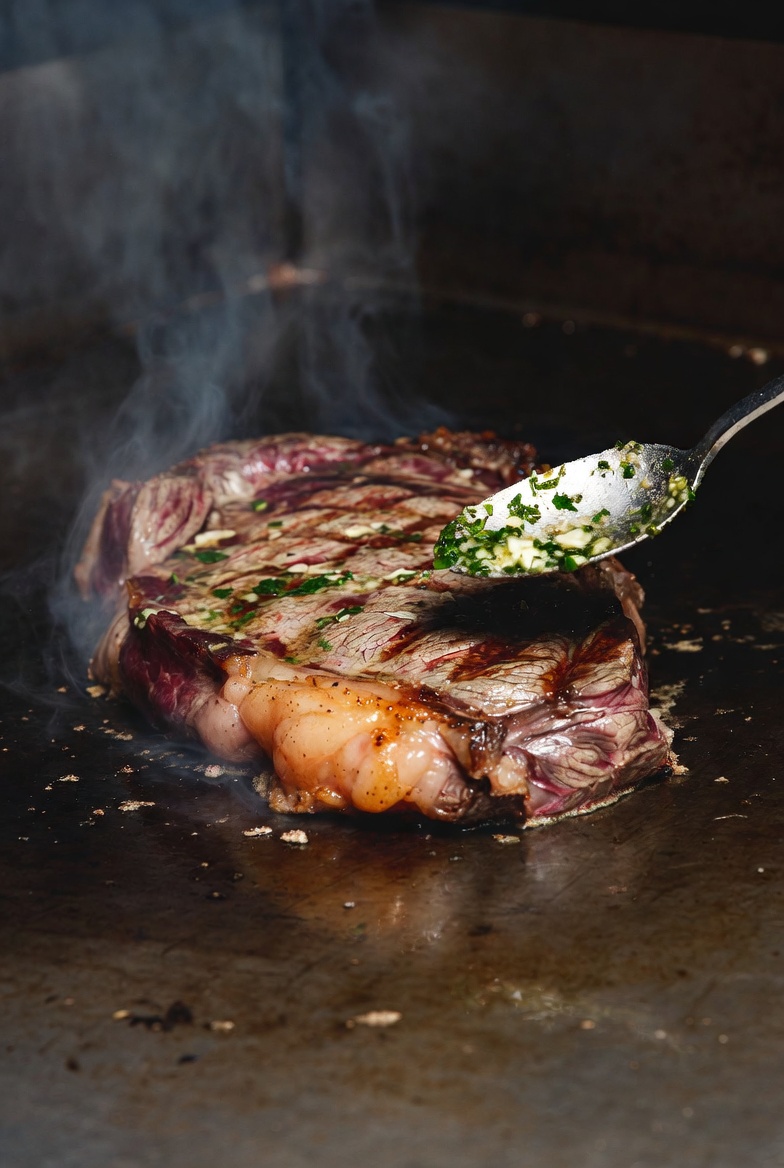
- As butter melts and foams, use a spatula to spoon it over the top of the steaks repeatedly for about a minute to baste them.
- Remove steaks from griddle and place on a cutting board or plate. Spoon some of the garlic herb butter over the top. Let rest for at least 10 minutes before serving.
- After resting, slice against the grain if desired or serve whole. Add a bit more salt if needed and pour over any accumulated juices from the cutting board.
Notes
- Pull steaks at about 130°F for medium-rare as they will continue cooking while resting
- Create different heat zones on the griddle by adjusting individual burners - sear over high heat, then move to cooler zone to finish if needed
- Any moisture on steak surface must evaporate before browning can start, so pat very dry
- Give griddle a full 15 minutes to preheat for best results
- Season more generously than you think necessary
- Don't use butter at the start as it will burn at high temperatures - add it at the end for basting
- Steaks should release easily from griddle when crust is properly formed - if sticking, they're not ready to flip
- Don't skip the 10-minute rest period or juices will run out when cut
- Leave space between steaks on the griddle - don't overcrowd
- Start with a clean griddle surface every time
The thing about cooking steak on a Blackstone is that it’s almost stupidly simple, but there are a few specific things you need to get right. The surface area means you can cook multiple steaks at once without crowding them. The heat retention is unreal. And the cleanup is easier than a traditional grill because everything stays on that flat surface. I’m still learning all the tricks, but what I’ve figured out so far has completely changed how I think about cooking steak at home.
Why the Blackstone Makes Better Steaks
Before we get into the actual recipe, let me explain why this works so well. A Blackstone griddle can hit temperatures around 500-600 degrees when you really crank it. That entire flat surface becomes a massive heat conductor. When your steak hits that surface, you get complete contact across the entire bottom of the meat. Compare that to a grill where you only get contact at the grate lines, or a pan where you might have hot spots. The Blackstone gives you an even, intense sear across every inch.
Plus, you can manage multiple steaks easily, and if you want to throw some onions or mushrooms on there at the same time, you’ve got the room to do it. Bronco and Gunner have figured out that when they hear the Blackstone fire up, something good is about to happen. They plant themselves about six feet from the griddle and refuse to move.
What You’ll Need
Ingredients
- 2-4 ribeye or New York strip steaks, about 1 to 1.5 inches thick
- Kosher salt
- Fresh cracked black pepper
- 2-3 tablespoons of high-heat cooking oil (avocado oil or regular vegetable oil work great)
- 4 tablespoons of butter
- 4-5 cloves of garlic, smashed
- Fresh thyme or rosemary sprigs (optional but recommended)
Equipment
- Your Blackstone griddle (I’m using the 36-inch model)
- Long-handled spatulas (the Blackstone ones are solid)
- Instant-read meat thermometer
- Squeeze bottle for oil
- Paper towels
Step-by-Step Instructions
Step 1: Prep Your Steaks (30-60 Minutes Before Cooking)
Take your steaks out of the fridge at least 30 minutes before you plan to cook. An hour is even better. You want them to come up close to room temperature. Cold steaks don’t cook evenly, and you’ll end up with a gray band of overcooked meat around the edges before the center comes up to temp.
Pat them completely dry with paper towels. This is important. Any moisture on the surface will steam instead of sear, and you’ll lose that crust we’re chasing. I go over each steak two or three times with fresh paper towels until they feel tacky and dry to the touch.
Season generously with kosher salt on both sides. I’m talking more than you think you need. A good coating. Then hit them with fresh cracked black pepper. That’s it for now. Don’t overcomplicate it. The Blackstone is going to create so much flavor with the sear that you don’t need a complicated rub.
Step 2: Preheat the Blackstone (10-15 Minutes)
This is where a lot of people mess up with any griddle cooking, but especially with steak. You need to get that surface HOT. I turn all my burners to high and let the griddle preheat for a solid 10-15 minutes. You want the surface temperature around 500-550 degrees.
If you have a dual probe infrared thermometer, use it. If not, you can test by flicking a few drops of water onto the surface. If they instantly ball up and dance around before evaporating within a second, you’re ready. If they just sit there and slowly evaporate, keep heating.
The griddle top will start to show a slight shimmer when it’s properly hot. You might see a bit of smoke if there’s any residual seasoning oil on there, which is totally normal.
Step 3: Oil the Griddle
Right before the steaks go on, add your oil. I use a squeeze bottle to make this easier. You want a thin, even layer across the zone where you’ll be cooking. Don’t use butter at this stage because it’ll burn at these temperatures. Save the butter for later.
Spread the oil around with a paper towel held in your tongs, or just let it spread naturally as it heats. You’ll see it shimmer and start to smoke slightly. That’s your signal that it’s go time.
Step 4: Sear the Steaks (3-4 Minutes First Side)
Lay your steaks down on the griddle moving away from you. This prevents any oil from splashing toward you. You should hear an immediate, aggressive sizzle. If you don’t, your griddle isn’t hot enough.
Now here’s the hardest part: don’t touch them. Don’t press them down with your spatula. Don’t peek under them. Don’t move them around. Just let them sit there and develop that crust. I set a timer for 3 minutes so I’m not tempted to mess with them early.
You’ll see the edges start to brown and the sides will begin to cook up about a quarter inch. The smell will be incredible. After 3-4 minutes, use your spatula to lift the edge of one steak and check the bottom. You want a deep, dark brown crust. Not black and burnt, but definitely dark brown. If it’s not there yet, give it another minute.
Step 5: Flip and Sear Second Side (3-4 Minutes)
Once you’ve got that crust, flip the steaks. They should release easily from the griddle surface. If they’re sticking, they’re not ready to flip yet. Give them another 30 seconds and try again.
After flipping, again, leave them alone. Another 3-4 minutes depending on thickness and desired doneness. This is when I start checking internal temperature.
Step 6: Check Temperature and Add Butter
For temperature, here’s what you’re looking for with an instant-read thermometer inserted into the thickest part:
- Rare: 120-125°F
- Medium-rare: 130-135°F
- Medium: 135-145°F
- Medium-well: 145-155°F
- Well-done: 155°F and up (but seriously, don’t do this to a good steak)
I pull my steaks at about 130°F for medium-rare because they’ll continue cooking while they rest. When the steaks are about 5-10 degrees away from your target temperature, add the butter directly onto the griddle around the steaks. Throw in your smashed garlic cloves and herb sprigs right into that butter.
As the butter melts and starts to foam, use your spatula to spoon it over the top of the steaks repeatedly. This is called basting, and it adds incredible richness and helps the top surface cook a bit more. Keep basting for about a minute.
Step 7: Rest the Steaks (10 Minutes)
Pull the steaks off the griddle and put them on a cutting board or plate. Spoon some of that garlic herb butter over the top. Then walk away. I know it’s hard. The steaks smell amazing. You’re hungry. But you need to let them rest for at least 10 minutes.
During the rest, the juices that have been driven to the center of the meat by the heat will redistribute throughout the steak. If you cut into it immediately, all those juices run out onto the cutting board and you end up with a drier steak. Let them rest, and you’ll have a much juicier result.
This is usually when I clean the griddle while it’s still hot. I use my Blackstone scraper to get off any stuck bits, wipe it down, and give it a light coat of oil.
Step 8: Slice and Serve
After resting, slice against the grain if you want, or serve the steaks whole. Hit them with a tiny bit more salt if needed. Pour over any accumulated juices from the cutting board.
The first time I did this whole process, I honestly couldn’t believe the difference. The crust was restaurant-quality, the inside was perfectly medium-rare, and the butter basting added this richness that made the whole thing taste like it came from a steakhouse.
Pro Tips I’ve Figured Out
Use the zones: One thing I learned quickly is that you can create different heat zones on a Blackstone by adjusting individual burners. If your steaks are getting too much crust before the inside cooks, move them to a cooler zone to finish. I usually sear over high heat on the right side of my griddle, then move steaks to medium heat on the left side to finish if needed.
Don’t cook straight from the fridge: I mentioned this already but it’s worth repeating. Cold steaks are the enemy of even cooking. Room temperature steaks will give you a much better result with less of that gray overcooked band around the edges.
Dry surface equals better crust: Any moisture on the steak surface has to evaporate before browning can start. The drier you get those steaks before they hit the griddle, the better your crust will be.
Don’t skimp on preheating: The Blackstone needs time to heat evenly across the entire surface. When I first got the griddle, I was impatient and started cooking too early. The results were mediocre. Now I always give it a full 15 minutes, and the difference is huge.
Season more than you think: The salt and pepper you put on the raw steak seems like a lot, but some of it will fall off, and you need enough to form a proper crust. I learned this after a few attempts where the steaks were under-seasoned. Be generous.
Invest in a good thermometer: Guessing on steak doneness is a recipe for disappointment. An instant-read thermometer takes the guesswork out completely. I use mine every single time now.
Common Mistakes to Avoid
Moving the steaks around too much: This was my biggest problem when I started. I wanted to check them constantly. But every time you lift or move a steak, you interrupt the crust formation. Put them down and leave them alone until it’s time to flip.
Cooking on medium heat: You need high heat for steak. Medium heat will cook the steak, sure, but you won’t get that crust. The Blackstone can handle the high temperatures, so use them.
Using butter too early: Butter burns at high heat. If you put it on the griddle at the start, it’ll turn black and bitter. Add it at the end for basting, not at the beginning for searing.
Skipping the rest period: I know I already covered this, but it’s such a common mistake. Cutting into your steak immediately means all the juice runs out. Just wait the 10 minutes. It’s worth it.
Overcrowding the surface: Even though the Blackstone has tons of room, make sure there’s space between steaks. They need air circulation, and you need room to work around them for flipping and basting.
Not cleaning the griddle first: If there’s old food stuck to your griddle surface from your last cook, it’ll interfere with your sear and can add off flavors. Start with a clean surface every time.
Frequently Asked Questions
What’s the best cut of steak for the Blackstone?
I’ve had great results with ribeye and New York strip. Both have enough fat to stay juicy during the high-heat cooking. Ribeyes are more forgiving because of the extra marbling. I’d avoid really lean cuts like sirloin for this method since they can dry out. Filet mignon works but needs careful attention because it’s so lean.
How thick should the steaks be?
I aim for 1 to 1.5 inches thick. Any thinner and they’ll overcook before you get a good crust. Any thicker and the outside might burn before the inside cooks. If you have really thick steaks like 2 inches, you might need to finish them on a cooler zone or even in the oven.
Can I use a marinade?
You can, but honestly, with the crust you get from the Blackstone, a good steak doesn’t need it. If you do use a marinade, pat the steaks extra dry before cooking. All that liquid will prevent proper browning. I prefer to keep it simple with just salt and pepper and let the beef and the crust do the talking.
What temperature should the Blackstone be?
For steak, I’m aiming for 500-550°F on the griddle surface. That’s with the burners on high after about 15 minutes of preheating. If you don’t have an infrared thermometer, the water drop test works great.
How do I know when to flip?
When the steak releases easily from the surface and has a dark brown crust on the bottom. Usually this is 3-4 minutes on the first side. If the steak is sticking when you try to lift it, it’s not ready. The crust will release naturally when it’s properly formed.
Should I oil the steak or the griddle?
Oil the griddle. You want a thin layer across the cooking surface. Oiling the steak doesn’t work as well because the oil just drips off and doesn’t create an even coating on the hot surface.
Can I cook frozen steaks?
I haven’t tried it myself yet, but I’ve read that you can. You’d need to sear them frozen to get a crust, then move them to a cooler zone to finish cooking through. Honestly though, for best results, thaw them in the fridge overnight and bring them to room temperature before cooking.
What do I do if the steaks are cooking too fast?
Turn down the burners in one zone to create a cooler area. Move the steaks there to finish cooking at a gentler temperature. This is especially useful if you like your steak more medium or if you’re working with thicker cuts.
Do I need to season the griddle first?
If your Blackstone is already seasoned, you’re good to go. Just make sure it’s clean before you start. If it’s brand new, you’ll need to do an initial seasoning, but that’s a whole separate process. For ongoing maintenance, I wipe it down with oil after each cook, and that keeps the seasoning layer built up.
What to Serve With Your Griddle Steaks
The beautiful thing about cooking on the Blackstone is that you’ve got room to cook sides right alongside your steaks. I usually throw some sliced onions and mushrooms on there about halfway through the steak cooking time. They soak up some of that steak flavor and butter, and they’re ready when the steaks come off.
Asparagus works great on the griddle too. Just toss it with a bit of oil, salt, and pepper, and cook it on medium-high heat for about 5-6 minutes. You can also do peppers, zucchini, or pretty much any vegetable that can handle high heat.
If you want to get ambitious, you could even do some smashed potatoes on there. Par-boil small potatoes, smash them flat, and crisp them up on the griddle with some butter. But honestly, sometimes I just want the steak with a simple salad and maybe some good bread.
Final Thoughts
I know I’m still pretty new to the whole Blackstone thing, but cooking steak on it has been one of those moments where you realize you’ve been doing something the hard way for years. The even heat, the incredible crust, the ability to cook multiple steaks at once without losing temperature, and the ease of adding butter and aromatics right there on the flat top—it all just works.
Sierra said the first griddle steaks I made were better than the ones we’d had at restaurants recently, which might have been a slight exaggeration but still felt pretty great to hear. The dogs have now trained themselves to appear in the backyard the second they hear the ignition click, which tells you everything you need to know about how good the smell is.
The key things to remember are: get the griddle screaming hot, don’t skip the room temperature rest before cooking, don’t move the steaks around, use a thermometer to check doneness, and let them rest after cooking. Follow those rules, and you’re going to end up with steaks that rival anything you’d pay serious money for at a steakhouse.
Now if you’ll excuse me, I need to go start preheating. I’ve been writing about steak for the past hour and I’m absolutely starving.