How to Fix Blackstone Griddle Not Lighting (Easy Steps)
Nothing quite matches the sinking feeling of turning your Blackstone’s gas valve, hitting the ignition button, and hearing… nothing. Or maybe you hear the gas hissing but see no flame. Trust me, I’ve been there, and that moment of “great, now what?” hits different when you’ve got burgers thawed and people expecting dinner.
Here’s the good news: a Blackstone that won’t light is usually something you can troubleshoot yourself in about fifteen minutes. Most of the time, it’s not a catastrophic problem—just one of a handful of common issues that are pretty straightforward to fix once you know what to look for.
I’m going to walk you through exactly how to diagnose and fix a Blackstone griddle that won’t light, in the order you should check things. We’ll start with the simplest possible causes and work our way up to the slightly more involved fixes.
Why Your Blackstone Won’t Light: The Main Culprits
Before we dive into the step-by-step fixes, it helps to understand what actually needs to happen for your griddle to light. You need three things: gas flow, a spark, and those two things meeting at the right place at the right time. When one of these elements fails, you get no flame.
The most common reasons a Blackstone won’t light are:
- Empty or improperly connected propane tank
- Closed or partially closed gas valves
- Safety mechanism engaged (gas flow restriction)
- Dead ignition battery
- Clogged burner tubes or ports
- Misaligned ignition electrode
- Debris or grease blocking the burner
- Faulty regulator
The good news? You can check and fix most of these yourself without any special tools.
What You’ll Need
Before you start troubleshooting, gather these items:
- Your Blackstone griddle (obviously)
- Propane tank
- AA battery (if your igniter needs replacing)
- Long-reach lighter or matches (for testing)
- Screwdriver (usually Phillips head)
- Wire brush or pipe cleaner
- Flashlight or phone light
- Shop towel or rag
- Soapy water in a spray bottle (for leak testing)
Step-by-Step: How to Fix a Blackstone That Won’t Light
Step 1: Check the Obvious Stuff First
I know this seems almost insulting to mention, but start with the basics because they’re the most common culprits:
Is there actually propane in your tank? Pick it up. An empty 20-pound propane tank weighs about 17-18 pounds. A full one weighs around 37-38 pounds. If it feels suspiciously light, you might just need a refill.
Is the propane tank valve open? Turn it counterclockwise to open. It should turn relatively easily.
Are all the burner control knobs in the OFF position before you try to light? This matters for the next step.
Step 2: Reset the Safety Mechanism
Here’s something that trips up a lot of people: propane regulators have a built-in safety feature that restricts gas flow if it detects what it thinks might be a leak. This can get triggered if you open a burner valve before the propane tank valve, or if you open valves too quickly.
When this safety engages, you might hear gas flowing, but it’ll be a weak flow—not enough to sustain a flame, or sometimes just enough to light briefly then go out.
Here’s how to reset it:
- Turn all burner control knobs to OFF
- Turn the propane tank valve completely OFF (clockwise)
- Disconnect the regulator hose from the propane tank
- Wait 60 seconds (seriously, wait the full minute—this lets the system reset)
- Reconnect the regulator hose to the propane tank, hand-tightening only
- Slowly turn the propane tank valve to OPEN (counterclockwise)
- Wait 10 seconds
- Now slowly turn one burner knob to the ignition position and press the igniter
This reset process fixes the problem probably 40% of the time when people think their Blackstone won’t light. The key is doing everything slowly and in the right order.
Step 3: Test the Ignition System
If you’ve reset the system and you’re still not getting a flame, let’s figure out if it’s a gas problem or a spark problem.
Check for spark: With the propane tank OFF, turn one burner knob to ignition and press the igniter button. Look closely at the electrode (the small metal probe near the burner). You should see a bright blue spark jumping from the electrode to the burner. Do this in shade or dimmer light if you need to—it’s easier to see the spark.
If you see a good strong spark, your ignition system is fine. The problem is gas flow. Skip ahead to Step 5.
If you see no spark or a very weak orange spark, you’ve found your problem. Move to Step 4.
Step 4: Fix the Ignition System
Replace the battery: Most Blackstone ignition systems run on a single AA battery housed in a small compartment, usually on the front or side of the griddle. Open the battery compartment, pull out the old battery, and pop in a fresh one. Make sure the polarity is correct (+ and – aligned properly).
Test the spark again. If you now have a good spark, you’re done with this step.
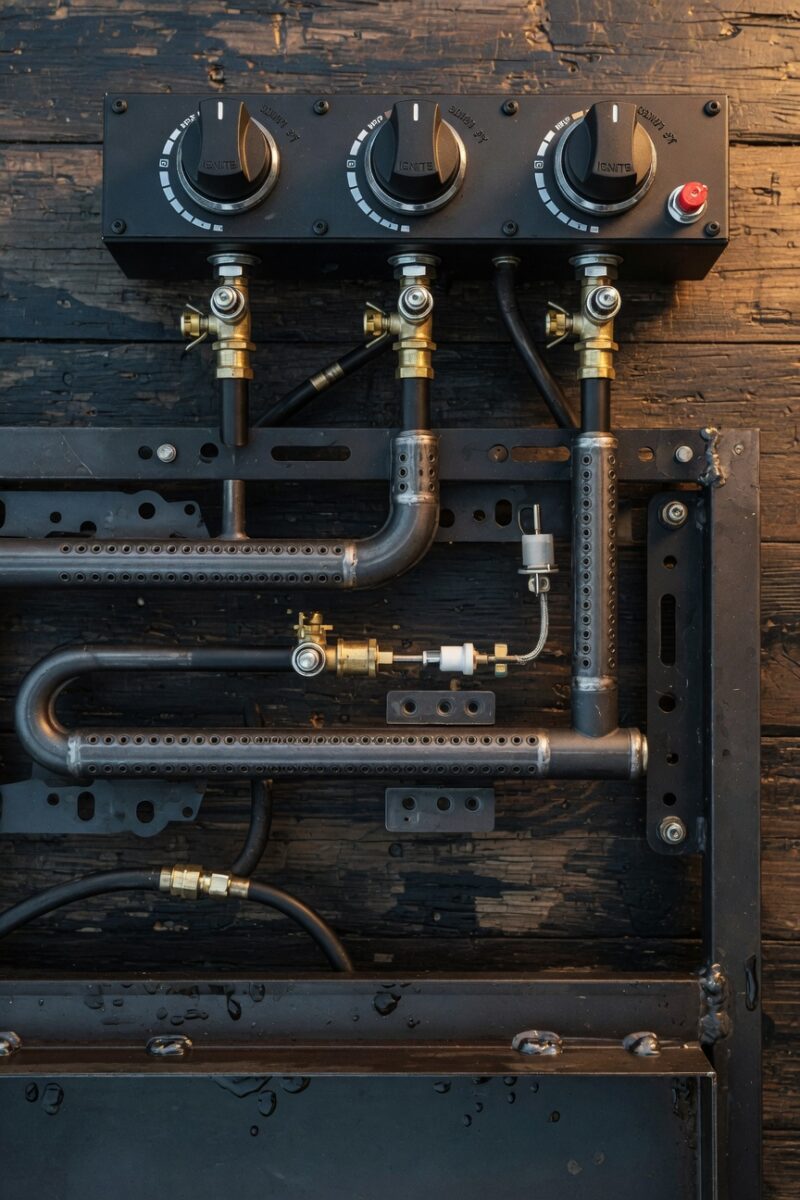
Check the electrode position: If you’re still not getting a spark even with a fresh battery, the electrode might be misaligned or dirty. The electrode needs to be positioned about 1/8 to 1/4 inch away from the burner to create a proper spark.
Look at where the electrode sits relative to the burner tube. If it’s bent away or touching the burner, carefully bend it back into position. If it’s covered in grease or crud, wipe it clean with a shop towel.
If you’re getting a spark now, great. If still nothing, you might need to replace the igniter assembly, but try everything else first.
Step 5: Check for Gas Flow
Now we know if you have spark. Let’s make sure you have gas reaching the burners.
With all burner knobs OFF, turn the propane tank valve to OPEN. Slowly open one burner valve and listen. You should hear a clear hissing sound of gas flowing. If you hear nothing, or just a very faint hiss, gas isn’t reaching the burner properly.
Check the connection: Turn everything off and disconnect the regulator from the tank again. Look at the coupling—is the rubber O-ring inside damaged, dried out, or missing? That could cause a poor seal. If it looks bad, you’ll need to replace the regulator hose assembly.
Test with manual ignition: This is the definitive test. With the propane tank valve open, turn one burner to high, wait five seconds for gas to reach the burner, then carefully light it manually with a long-reach lighter or match at the burner port. Hold the flame near the burner tube holes.
If it lights immediately and burns with strong blue flames, your gas flow is fine—you just have an ignition problem. Go back to Step 4.
If it lights but the flames are weak, yellow, or sputtering, you have restricted gas flow. Continue with this section.
If it won’t light at all even manually, you’re definitely not getting gas. This points to a tank issue, regulator issue, or valve issue.
Step 6: Clear Clogged Burners
Burner tubes can get clogged with grease, food debris, or even spider webs and insect nests (yes, really—spiders love to nest in burner tubes during the off-season).
Turn off the gas and disconnect the propane tank completely before doing this.
Remove the griddle top if possible to access the burners. On most Blackstones, you can lift off the cooking surface to see the burner tubes underneath.
Look into the burner tubes with a flashlight. See any blockages? Use a wire brush or straightened wire hanger to carefully clean out the inside of each burner tube. You can also use a pipe cleaner for the smaller gas ports along the burner.
If you see blockages in the small burner ports (the holes along the burner tube where flames come out), use a thin wire or even a toothpick to clear each one. Be gentle—you don’t want to enlarge the holes.
Once you’ve cleaned the burners, reassemble everything, reconnect the propane tank following the reset procedure from Step 2, and try lighting again.
Step 7: Inspect and Test the Regulator
If you’ve done everything above and you’re still getting weak gas flow or no flow at all, the regulator itself might be faulty.
The regulator is the brass-colored device that connects your hose to the propane tank. Its job is to reduce the high pressure in the tank to the lower pressure your griddle needs. When regulators fail, they usually restrict flow too much or fail to regulate pressure properly.
Here’s a simple test: disconnect your Blackstone’s regulator and connect a different propane appliance you know works—like a propane grill if you have one. If that other appliance works fine with your propane tank, but your Blackstone’s regulator doesn’t, you’ve found your problem. You’ll need to replace the regulator hose assembly.
Blackstone sells replacement regulator assemblies on their website and through retailers. They’re not expensive—usually around $20-30—and they’re easy to swap out. Just screw off the old one and screw on the new one.
Step 8: Check for Leaks
This is more of a safety check than a troubleshooting step, but it’s worth doing, especially if you’ve been connecting and disconnecting things.
Mix up some soapy water in a spray bottle (just a squirt of dish soap in water). With the propane tank valve open but all burner knobs closed, spray the soapy water on all the connections—where the regulator meets the tank, where the hose connects to the griddle, and around any valve stems.
Watch for bubbles forming. Bubbles mean gas is leaking at that connection. If you see bubbles, turn off the gas immediately, tighten that connection, and test again. If it still leaks after tightening, that component needs to be replaced.
Common Mistakes When Troubleshooting
Opening the tank valve too fast: This can actually trigger the safety mechanism you’re trying to fix. Always open the propane tank valve slowly.
Not waiting long enough during the reset: That 60-second wait when the tank is disconnected actually matters. The system needs time to fully depressurize and reset.
Turning burners on before the tank: Always open the propane tank valve first, wait a moment, then open burner valves. Doing it backward can trigger gas flow restriction.
Ignoring the gas smell: If you smell gas while troubleshooting, turn everything off immediately. Check all connections for leaks before proceeding. Never continue trying to light a griddle when you smell a significant gas leak.
Over-tightening connections: The connection between the regulator and propane tank should be hand-tight only. Over-tightening can actually damage the seal and cause leaks or connection problems.
Assuming the tank is full just because it’s heavy: Propane tanks can corrode inside and hold water, making them heavy even when there’s no propane left. If your tank seems heavy but you’re getting no gas flow, try a different tank to rule this out.
Not checking all the burners: Sometimes only one burner won’t light because of a clog specific to that burner, while others work fine. Test each burner individually.
Pro Tips
Keep spare batteries on hand: Toss a 4-pack of AA batteries in your griddle accessories box. Dead igniter batteries always seem to happen right when you’re starting to cook.
Clean regularly to prevent issues: A lot of lighting problems come from buildup and blockages that develop over time. Using a griddle cleaning kit after each use prevents most of these issues and keeps your burners clear.
Cover your griddle when not in use: A weather resistant cover keeps insects, debris, and moisture away from the burners and ignition system. Worth the investment.
Always keep a long lighter nearby: Even when your ignition system works perfectly, having a backup manual lighting option gives you peace of mind. I keep one hanging on a hook next to the griddle.
Do the full reset procedure after winter storage: If your Blackstone has been sitting unused for months, go through the full reset procedure from Step 2 before expecting it to light normally. The safety mechanism often needs resetting after long storage.
Check connections at the start of each season: Give all your hoses and connections a visual inspection before your first cook of the season. Look for cracks, damage, or wear.
Know when to call it: If you’ve been through all these steps and your Blackstone still won’t light properly, it might be time to contact Blackstone customer support or take it to a professional. Some issues require replacement parts or expertise beyond basic troubleshooting.
Frequently Asked Questions
Why does my Blackstone light but then go out immediately?
This is almost always the safety mechanism restricting gas flow. The small amount of gas in the line when you first light it burns off quickly, then the restricted flow can’t sustain the flame. Follow the reset procedure in Step 2—that should fix it.
Can I use my Blackstone if the igniter doesn’t work?
Yes, absolutely. You can light your Blackstone manually with a long lighter or match. Just turn on the gas, wait a few seconds, then carefully light the burner at one of the ports. It’s not as convenient as the push-button ignition, but it works fine. That said, igniters are easy to fix—usually just a battery replacement.
How do I know if my propane tank is actually empty?
Besides weight (an empty 20-lb tank weighs about 17-18 pounds), you can pour a little warm water down the side of the tank. The level where the tank feels cold to the touch is where the liquid propane sits inside. No cold spot means empty or nearly empty. Or just take it to a refill station—they can tell you immediately.
Why do only some of my burners light?
If some burners light fine but others don’t, you’re looking at individual burner issues rather than a gas supply problem. Check those specific burners for clogs in the ports or burner tubes. Each burner tube can have its own blockages independent of the others.
Should I smell gas when my Blackstone won’t light?
You might smell a brief whiff of gas when you’re trying to light it, especially if gas is flowing but not igniting. However, you shouldn’t smell a strong continuous gas odor. If you do, turn everything off immediately and check for leaks using the soapy water method. Never keep trying to light a griddle that’s leaking gas.
How often should I replace my regulator?
Regulators don’t have a set lifespan, but they can wear out or fail. If you’ve ruled out everything else and you’re still having consistent pressure or flow issues, replacing the regulator is a good call. Some people replace them every few years as preventive maintenance, but that’s not strictly necessary if yours is working fine.
Can cold weather affect my Blackstone’s ability to light?
Yes, actually. Propane doesn’t vaporize well in very cold temperatures (below about 20°F). If you’re trying to use your griddle in seriously cold weather, the tank might not be generating enough gas pressure. Storing your propane tank somewhere warmer (but never indoors) before use can help.
What’s that clicking sound when I press the igniter?
That clicking is normal—it’s the sound of the piezo igniter or battery-powered sparker creating the spark. If you hear clicking but see no spark, the battery might be too weak to create a visible spark, or the electrode isn’t positioned correctly.
Can I clean my burners while they’re still installed?
You can do some cleaning with the burners in place, but for a thorough cleaning, it’s better to remove the griddle top and access the burners directly. This lets you see what you’re doing and really get into the burner tubes and ports properly.
When to Contact Blackstone Support
If you’ve worked through all these steps and your griddle still won’t light, or if you’ve discovered damage to components like cracked hoses or a faulty valve body, it’s time to reach out to Blackstone. Their customer support is actually pretty good—they can help diagnose more complex issues and send replacement parts if your griddle is under warranty.
Also contact them if you discover any damage you’re not comfortable repairing yourself, or if you smell gas but can’t locate the source of the leak even with soapy water testing.
Final Thoughts
A Blackstone that won’t light is frustrating, but it’s rarely a catastrophic problem. Most of the time, you’re looking at one of a few simple issues—a triggered safety mechanism, a dead battery, a clogged burner, or an empty propane tank. All of these are fixable with basic troubleshooting.
The key is being methodical. Start with the simplest possible causes and work your way through the steps in order. Don’t skip the reset procedure—I know it seems too simple to matter, but that safety mechanism gets triggered more often than you’d think.
Once you get your griddle lit and running again, think about what caused the issue in the first place. Was it a clogged burner? Clean more regularly. Dead battery? Keep spares around. Triggered safety mechanism? Make a mental note about the proper lighting sequence.
The more you use your Blackstone, the more you get a feel for how it should sound and behave when everything’s working right. That makes it easier to spot when something’s off. And honestly, going through this troubleshooting process once or twice actually makes you more confident in using and maintaining your griddle going forward.
Now get that thing lit and get cooking. You’ve got this.